 strateva
This Apple strategy tracks where the close falls within the day's range and combines it with two exponential moving averages, over 8 and 24 sessions. The notebook uses the final close to make the decision and simulates the trade at that same price. I repeated the test in Docker with the same signals and orders at the next open. Original notebook
The open can improve or worsen a trade
The first buy signal arrived on March 16, 2011. The notebook bought at the close for $11.79 in adjusted prices. Apple opened the following day at $12.03. Executing both the entry and exit at the next open reduced this trade's return from 6.35% to 4.10%.
Of the 53 matched trades, the next open gave a better result in 33 and the close in 20.
The full historical result
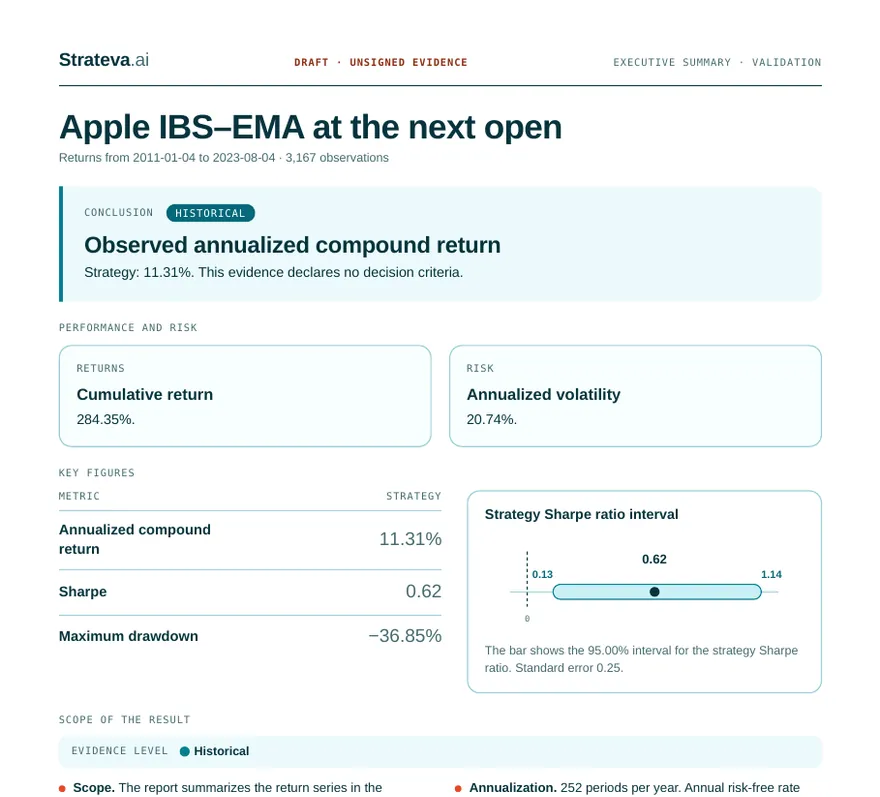
From January 2011 to August 2023, the literal replay gained 209.87% and the next-open version gained 284.35%. Both use prices that exclude dividends and follow the notebook's cost assumptions, with zero commissions, spread and slippage. Any position still open when the sample ends is closed at the final close.
What the engine measured
Cumulative return
Worst drawdown from a peak
Ratios, with their 95% interval
- Strategy
- Resampling range or 95% interval
Source: technical report of the test, linked below. Prices exclude dividends; the resampling uses the same historical series.
The technical report adds the margin of error to these figures. The Sharpe of the strategy was 0.62, with a 95% interval of 0.13 to 1.14. This report includes no reference, so there is no test against one.
When the same returns were resampled in blocks, the cumulative return fell between 27.56% and 1,015.43% in the central 90%, and the worst drawdown between 23.24% and 55.03%. What that resampling measures is explained in Block bootstrap and permutation Monte Carlo.
Test reports
How to read this document is explained in the guide to the technical report.
How to read both documents is in the guide to the technical report.
The PDFs document the next-open variant.
See Strateva's services if you want to check how execution affects your signals.